
What Does a Missed Call Really Cost Your Business?
- Thursday 17th September 2026
- Kevin Broughton
- On Hold
Ask most business owners how many calls they missed
last month and you will get a shrug.
Ask them how much they spent on marketing in
the same period and they will tell you to the penny.
That gap is worth closing, because the
two numbers are connected.
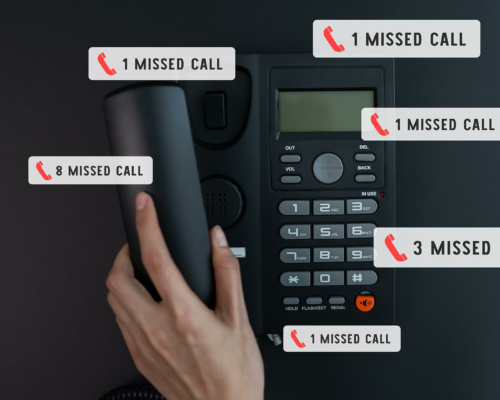
Every missed call is a person who wanted something from you. Some of them will ring back. Many will not. Understanding the cost of missed calls is the first step towards deciding whether it is worth doing something about them.
What counts as a missed call?
A missed call is any inbound call that does not reach a person who can help. That is broader than it sounds, and it includes:
- Calls that ring out because nobody is free to answer
- Calls that hit an engaged tone because your only line is in use
- Calls that go to voicemail and are never followed up
- Calls answered by someone who cannot help and does not take a message
- Calls where the caller hangs up while waiting on hold
That last one matters more than people expect. Research commissioned in 2025 found that almost a third of UK consumers will abandon a call within ten minutes, even when their reason for ringing is urgent.
How to work out what a missed call costs you
You do not need sophisticated analytics. You need four numbers you already have or can estimate.
Step one: your average order or job value. Take last year's revenue and divide it by the number of jobs, orders or clients. Call this figure A.
Step two: your conversion rate from enquiry to sale. If one in three enquiries becomes a customer, that is 33 per cent. Call this figure B.
Step three: multiply A by B. This is the average value of a single inbound enquiry. A business with a £600 average job value converting one enquiry in three is looking at roughly £200 per call.
Step four: estimate your missed call volume. Check your phone system logs, your mobile's call history, or simply count for a fortnight and double it.
Twenty missed calls a month at £200 each is £48,000 a year walking out of the door. Even if half of those callers ring back, the remaining figure is usually larger than the cost of doing something about it.
Do not forget the second-order costs
The direct revenue loss is only part of it. Missed calls also carry:
- Wasted marketing spend. You paid to make that phone ring. If nobody answers, the click, the leaflet or the van livery has been paid for and discarded.
- Reputational cost. A caller who cannot reach you rarely blames your workload. They blame your business.
- Competitor gain. In trades, professional services and retail, the caller usually has a second name on their list.
Where missed calls actually happen
In our experience with UK businesses, missed calls cluster around a handful of predictable moments.
You are physically unable to answer. If you are on a roof, under a vehicle or in a client meeting, the phone is not an option. Sole traders and small field-based teams lose the highest proportion of calls this way.
Everyone is already on a call. A single line or a small team creates a hard ceiling. Once you hit it, the next caller gets an engaged tone.
Outside your advertised hours. Callers ring when it suits them, which is often before nine or after five. A well written out of hours message will not answer the call, but it will hold the relationship together until you can.
During holidays and staff absence. Predictable, avoidable, and still the single most common reason businesses come to us for temporary call handling cover.
While the caller is on hold. Silence on hold feels roughly twice as long as it is. Callers assume they have been cut off and hang up.
Five practical ways to stop losing calls
1. Fix your hold experience first
This is the cheapest fix available and it is often the one with the fastest return. Silence and repetitive beeps push callers off the line. Professionally produced on hold messages reassure the caller that they are still connected, and use the waiting time to tell them something useful about your services.
If you use commercially released music on your phone system, bear in mind that this counts as a public performance and usually requires TheMusicLicence from PPL PRS. Royalty free on hold music avoids that obligation entirely.
2. Route calls properly before they queue
A clear IVR menu gets callers to the right person first time. Keep it to four or five options, put the most common request first, and always offer a route to a human.
3. Remove the single-line ceiling
If an engaged tone is a regular occurrence, the underlying phone system is the problem. A VoIP phone system removes the fixed line limit and lets calls ring on multiple devices at once.
4. Make your mobile behave like a phone system
If you genuinely run the business from your mobile, you do not need to give up professionalism to do it. The Mobile Connect Platform links your business number to your handset, so callers hear a proper welcome greeting and on hold messages rather than your personal voicemail.
5. Put a human behind the calls you cannot take
When the calendar is full and the phone is still ringing, a customer support centre gives you trained people who answer as though they work for your business. They can take messages, book appointments, capture leads or work directly in your systems, depending on how much you want them to do.
Frequently asked questions
- How many missed calls is normal for a small business?
There is no useful benchmark, because it depends entirely on call volume and team size. What matters is your own figure and its trend. Measure it for a month, act, then measure again. - Is voicemail enough?
Rarely. Voicemail captures a fraction of callers, and the ones it does capture have already formed an impression. It works best as a safety net behind a live answering arrangement, not as a substitute for one. - Will an answering service sound like an answering service?
It should not. A well briefed team using your business name, your greeting and your booking system is indistinguishable from an in-house receptionist to most callers.
Work out your number, then decide
The point of this exercise is not to feel bad about calls you have already lost. It is to replace a vague worry with a figure you can act on. Once you know what a call is worth, deciding whether to invest in answering them becomes a simple piece of arithmetic.

If you would like a hand with that, get in touch with the team or request a free audio demo to hear how your calls could sound.
About us and this blog
Onhold Studio has been developing custom on hold audio messages for almost two decades! We specialise in audio marketing for both VoIP and conventional telephone systems. Our team can handle every step of the process for you, whether you need music or on hold messaging, call menu options, or out-of-hours audio messages.